Overview
Solar electric systems are the ideal way to produce your very own power, cutting your monthly energy bills, allowing for energy independence, or even going completely off the grid.
These systems are available in small and large sizes, can be custom sized to fit your household, and allow you great independence and energy savings. In many areas, the electricity produced can even be sold back to the grid for even more savings or a profit.
Benefits of Solar Electric PV Systems
Cut your electric bills: The energy from the sun is free, so once you've paid for the initial cost of your solar pv system, you generate free electricity – with no cost to you.
Generate money with your PV system: In many areas, there are SRECs (Solar Renewable Energy Credits) that you generate for the power your PV system produces – even if you use the power. These credits can be sold every month, generating income – while still reducing your electric bills.
Sell energy to the grid: With grid-connected PV systems, you can often sell the energy you don't use back to the power company (aka, the grid). This often results in a credit, or even income paid to you by the power company.
Contribute to a clean environment: Solar energy in all forms is clean, and contributes to a reduced carbon footprint. Renewable energy, unlike fossil fuels, doesn't release harmful gases or pollutants. By installing a solar PV system, you contribute to reducing your own personal carbon foot print, as well as help sustain a clean environment for the planet.
Energy independence: A solar PV system gives you independence and freedom from electric rate hikes and cost increases, and many systems can be configured to provide power during storms, blackouts, and other power outages. No noisy or costly gas generators, or inconvenient power losses, a solar PV system can give you the energy independence you deserve.
How a PV System Works
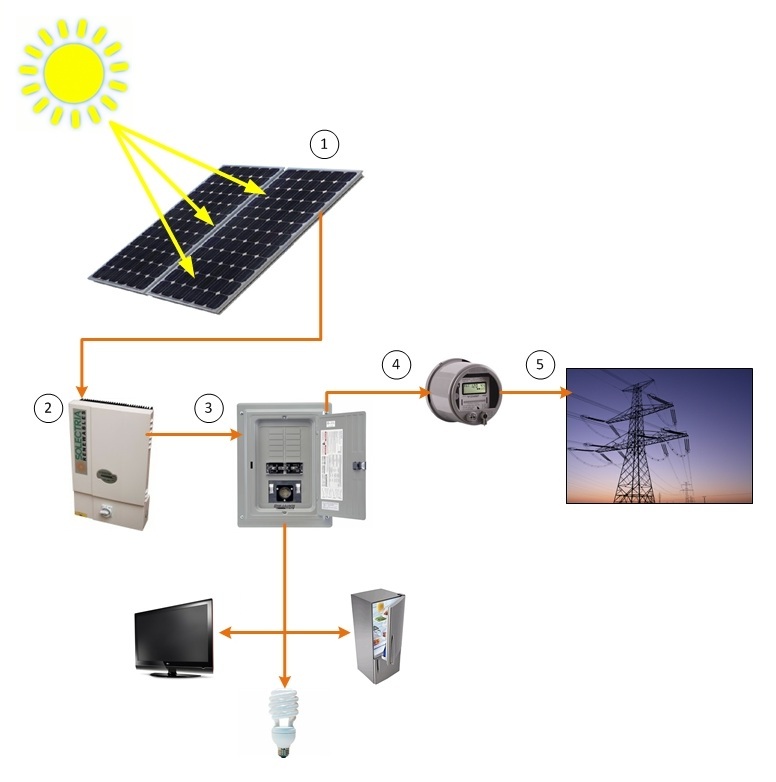 (1) When sunlight strikes the solar array, the panels begin to produce electricity. The electricity produced by solar PV panels is direct current (DC) electricity.
In order for your home to safely use this energy, it must first be converted from DC to AC (alternating current), which is what most homes use today.
(2) The DC power is fed into a solar inverter, where it is converted from DC to AC so the electricity will be compatible. Different types of solar inverters are used, depending on application.
For example, micro-inverters are a type of solar inverter that is mounted on the solar panel itself.
AC solar panels are also used, which produce AC current, and do not need to be run through a separate inverter. String inverters are very common as well, as they allow a number of PV panels to be fed into one device for conversion.
(3) The AC power is then fed into your service panel, so that the power can be supplied to various loads, such as your lights, refrigerator, or TV.
(4) When a surplus of power is generated (you are producing more power than you are using), the excess electricity is fed through your utility meter. In some areas, there is a separate utility meter for power being produced.
(5) This energy is then fed back to your power grid, which the power company will buy back from you. This can result in a credit, or in generating income in some areas, for energy you aren't using.
This is just one example of a grid-tied solar pv system. Other configurations, such as off-grid systems, or systems with battery backup are used as well. Grid-tied systems, however, are by far the most commonly installed PV systems. For more information on other types of systems, please contact us.
Packages
Solar Panels Plus offers complete home solar electric PV systems for locations all over the USA. These solar PV systems have been engineered and packaged to seamlessly integrate into your home's current electrical grid.
Available in a number of sizes and power outputs, these packages allow you to generate your own power for free, and drastically cut your electric bills - regardless if your power consumption is small or large.
These packages include the following components:
Solar PV Panels
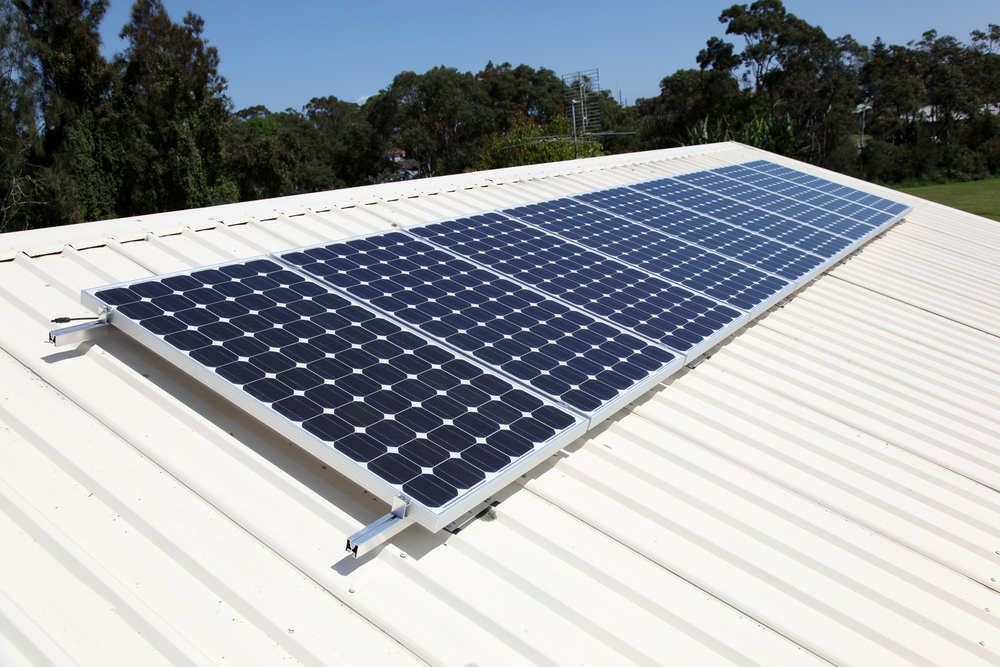 The solar PV panel array is the primary component in any home solar pv system. The PV panels used can be specified as Buy American Act Compliant, and come backed by a full 25-year warranty - ensuring reliable, free energy generation for decades to come.
These panels are UL tested and certified, complying with international safety standards. They are available in various sizes, such as a 230W and a 270W panel. These PV panels are also eligible for federal, state, and local rebates - drastically reducing the upfront cost of your entire solar pv system. For a full listing of incentives, please visit www.dsireusa.org.
Solar PV packages are sized for various electrical loads, and can contain as little as 6-8 PV panels, or as many as 20 or more PV panels. Various sizes are available depending on your electrical consumption, or we can quickly and easily size a custom package to meet your specific electrical demands and budget.
Our solar AC module can also be included in packages, making solar PV more affordable than ever before.
More information on our Solar PV Panels.
More information on our Solar AC Modules.
Solar Inverter
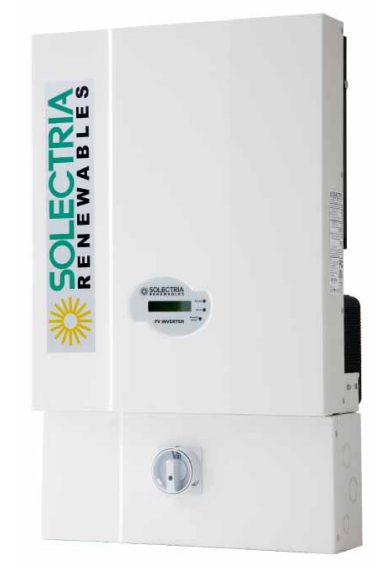 The solar inverter is another critical component to a home's solar PV system. The solar inverter takes the direct current (DC) power generated by PV panels, and converts it to usable alternating current (AC) so it can be safely used to power appliances and items in your home - or fed back to the power grid.
Solar inverters are available in two types of technologies - string inverters and micro inverters. Both types of solar inverters are included in our packages, and are available for home application.
String inverters allow all the solar panels to be wired together, and then fed into a single device. Our string inverters are American Made, high efficiency, and are backed by a full 10-year warranty.
Each string inverter has been sized to match the number of panels in each package, taking into consideration temperature variances, voltage, amperage, and the voltage and phase of the home.
Options are available for these inverters, such as remote & web based monitoring.
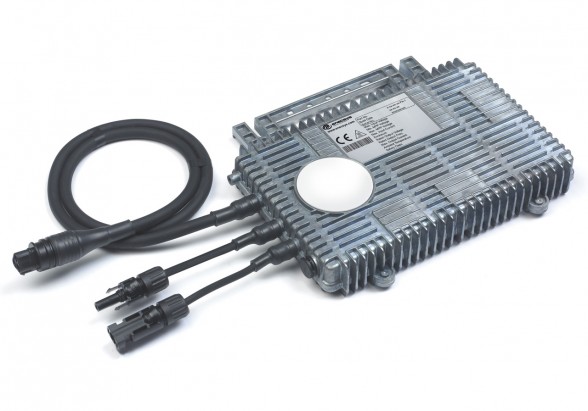 Micro-inverters are mounted onto each individual pv panel at the time of installation, inverting the electrical current from DC to AC right at the source. Our micro inverters are available from a number of manufactures, such as the well-known Enphase. They are reliable, high performance, and sized to match the number of panels in each system.
Micro-inverters also allow for increased customization options, giving you the freedom to get the exact power output you want for your home. Or you can come back later and add more panels easily, allowing you to slowly build up the size of your solar PV system over time.
More information on our solar inverters.
PV Racking
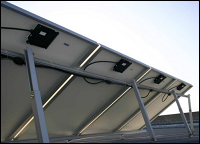 Each package includes a set of PV racking for your system. The racking is crucial for safe and easy mounting of your PV panels. Various options are available for racking, increasing the flexibility of where your PV panels are installed.
Roof mounting, ground mounting, and pole mounting options are just a few of the types available for your home PV system.
Ground mount or pole mount PV mounting systems can be used to install PV panels if you don't have the roof space or if shading is a problem.
More information on our solar pv roof mount racking systems.
More information on our solar pv pole & ground mount racking systems.
Charge Controllers
Charge controllers are included in our off-grid and battery backup pv systems. Charge controllers are a crucial part of any pv system that includes battery backup for storage.
These controllers use the latest technology to improve the lifespan of your batteries, and give you optimal charge for longer. They allow you to get the most out of your investment in an off-grid or battery backup system.
More information on our solar charge controllers.
PV Components & Balance of System
A number of other items are also included in each package that is built for your solar installer. This allows your installer to shop at a single place, and receive one shipment with everything he needs for a fast, safe, and simple install. Batteries, wiring, cables, and much more are available. For more information, please contact us.